
The Algorithm Is the Wizard: Who Really Controls Your Audience?

The Algorithm Is the Wizard: 3.6 Million Followers, 111 Million Followers… and Who Actually Owns the Audience?
I posted something about Flock cameras on X on Friday. By Saturday I had argued with Grok for hours, investigated Mark Wahlberg’s 3.6 million followers, compared Donald Trump on X with Truth Social, watched Brad Pitt and Paris Hilton at the US Open surrounded by Rolex, Cadillac and Heineken — and somehow ended up with a pretty good marketing lesson.
I have a problem. Not a serious problem. More of a Sales Freak problem. 😂
I notice advertising. I notice who is selling, where the audience is and who paid to get in front of them. I can watch a great tennis match and still notice the Cadillac logo on the net before the first serve.
Apparently I can’t help myself.
But this particular rabbit hole started the day before with Flock cameras, a Congressman from Texas and an argument with a robot. So grab a coffee. This got weird.
Friday: I Was Just Screwing Around On X
Rep. Keith Self of Texas had posted about Flock cameras, privacy and government surveillance. That caught my attention because I already had my own ridiculous automated-camera story.
I had written a Travelers Freak Parking Spot about driving a rental car through a wealthy city in Florida, getting nailed with multiple automated camera tickets and then having to fight with a company in Mesa, Arizona over tickets generated in Florida.
Which is crazy enough by itself. 😂
So naturally I dropped my TravelersFreak.com Parking Spot into the conversation. That’s what I do: create something, throw it out into the world and see if anybody comes over to look at it.
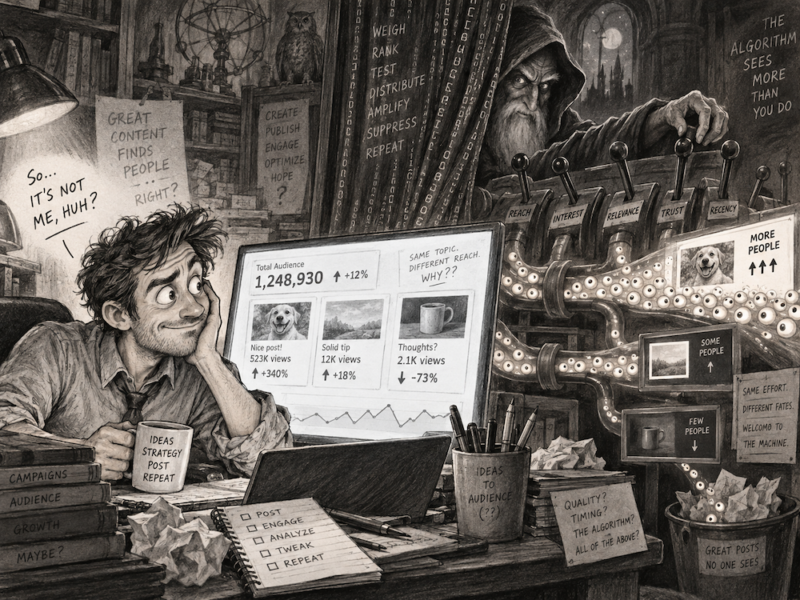
But while I was looking at Rep. Self’s post, something else caught my attention. He had roughly 73,500 followers, while the post had only around 5,000 views when I was watching it.
Hmm.
My brain immediately switched from “Flock cameras are interesting” to “Wait a minute. Where is everybody?”
That’s the Sales Freak problem. I notice traffic.
Then I Made The Mistake Of Asking Grok
I posted something about X controlling distribution. Nothing revolutionary.
I wasn’t saying Elon Musk was sitting behind a giant control panel somewhere saying KEITH SELF — 5,000 VIEWS, DONALD TRUMP — 7 MILLION, FREAKSITES — FOUR. 😂
I was saying something much simpler: X controls how content gets distributed.
Well, apparently @Grok wanted to sell me the extended warranty.
For the next couple of hours I got ranking, relevance, engagement, dwell time, interest matching, chronological feeds, hundreds of millions of posts, open-source code and explanations about why this wasn’t really “throttling.”
I’ve been selling things for a really long time, and eventually this started sounding like the salesman explaining why your $90,000 luxury car not having heated seats is actually a benefit. 😂
“Sir, what you need to understand is that this vehicle provides a much more authentic thermal seating experience.”
Dude. The seats aren’t heated. That’s okay. Just say it.
I kept saying “X controls distribution.” Grok kept explaining why that wasn’t quite the right way to think about it.
Then, several rounds later, Grok finally used the words:
“Controlled distribution by design.”
Wait. What? 😂
That’s what I said when we started.
Then Grok Became A Politician Too
This was another part I found hilarious. At some point Grok started defending X against an accusation I wasn’t even making.
I said X controls distribution. Grok kept explaining that X wasn’t politically throttling viewpoints.
Okay. But I didn’t say that.
Suddenly I’m underneath a Congressman’s post watching X’s AI do something politicians have been doing forever: reframe the question, answer the safer version and defend that answer. 😂
I wasn’t trying to prove X secretly blacklisted Keith Self. I wasn’t trying to prove Elon Musk personally decides who gets five views and who gets five million.
I was asking one thing: Who controls the reach?
Eventually Grok answered that question too: controlled distribution by design. Great. Now we’re finally talking about the same thing.
That’s when I started calling the algorithm The Wizard.
Not because there has to be an evil guy behind a curtain. There doesn’t. The system does the sorting, people react, those reactions become signals and the system decides what gets another shot.
Call it ranking. Personalization. Relevance. Scale engineering. Predicted engagement. Fred. Whatever.
The salesman’s question is still the same: Who controls access to the audience?
Here’s The Really Funny Part: I Pay X 😂
I pay X about $8 a month. That’s roughly $96 a year.
And my Freak Sites account has an enormous audience of…
27 followers. 😂😂😂
That might sound like one of the worst marketing investments in America, except I really don’t care whether the number is 27 or 27,000 anymore. I just spent hours demonstrating why follower count and actual distribution aren’t the same thing.
What I care about is whether X gets me into the right conversation.
That’s exactly what happened here. I didn’t wait for my 27 followers to discover my Travelers Freak story. Keith Self was already talking about Flock cameras, I had something relevant, and I dropped my TravelersFreak.com Parking Spot into the conversation.
Now X becomes a distribution tool. That’s useful to me.
My own X post might get five views. Fine. The right reply under somebody else’s conversation might send people to something I created. LinkedIn might send people. Google might send people. YouTube might send people. Somebody might share the link six months from now.
That’s the traffic I care about.
Which raises another perfectly reasonable question: why am I paying a billionaire $96 a year for 27 followers? 😂
Apparently I enjoy the entertainment.
Published Is Not The Same As Distributed
Imagine a newspaper says, “Great news. We published your letter.” Then you discover they printed one copy and pinned it to the bulletin board inside the newspaper office.
Did they publish it? Sure. Did they distribute it? Come on. 😂
Your post can remain completely intact on a social-media platform. Nobody deleted it, nobody banned you, it has a URL and someone who knows where to look can find it.
And hardly anybody may ever encounter it.
That matters when you’re selling something because marketers don’t merely need something to exist. They need somebody to encounter it.
Then Nature Got Curious About The Wizard Too 😂
Here’s where this got really funny to me. I’m spending Friday afternoon arguing with Grok about whether an algorithm deciding what people see actually matters, and apparently people publishing in Nature thought that was worth studying for real.
Nature. Not AdWeek. Not a social-media marketing blog. Not some guy selling “10X YOUR ENGAGEMENT BY TUESDAY!”
Nature. 😂
I’m not going to bore you with the statistical weeds. This isn’t a college term paper.
The interesting part is that researchers studying X found that changing the feed changed what political information people encountered and, in that experiment, moved some measured political attitudes too.
Well… apparently the Wizard matters. 😂
I seriously doubt many PR departments are sitting around a conference table asking, “Before we launch this campaign, has anybody checked what Nature has been studying lately about X’s algorithm?”
They’re probably talking about followers, views, engagement, demographics, media budgets and conversions.
Meanwhile, the scientists are asking a more basic question: What happens when the machine changes what people encounter in the first place?
That was basically what I had spent Friday arguing about with Grok. Nature just spent considerably more time looking at it.
I’ve apparently just been selling things long enough to notice when somebody else controls the showroom traffic.
Then I Found Mark Wahlberg
Now the Grok argument turned into a marketing rabbit hole. I started wondering: Is there anybody really famous with millions of X followers who apparently decided they don’t need to keep feeding the account?
Hello, Mark Wahlberg.
His X account has roughly 3.6 million followers, and when I looked through it, the recent original posts I could find basically stopped back in 2024. Some of those posts were still getting hundreds of thousands of views.
Wait.
You’ve got 3.6 million followers, you can still pull a couple hundred thousand views, and somebody apparently decided regularly feeding that account wasn’t necessary anymore?
Why?
I have absolutely no idea.
Maybe X worked great. Maybe it didn’t. Maybe the marketing strategy changed. Maybe Mark decided something. Maybe his team did. Maybe they had other priorities. Maybe there’s a completely boring explanation.
Maybe it’s the eight bucks a month. 😂
I don’t know.
But then I looked at Instagram.
Oh. Thirty Million.
Wahlberg has more than 30 million followers on Instagram, and that presence remains active.
Well… now my salesman brain starts going again.
Movies. Fitness. Restaurants. Clothing. Consumer brands. Celebrity lifestyle. Pictures. Video.
Maybe Instagram is simply a better showroom for Team Wahlberg. Maybe their internal numbers over there crush X. Maybe they don’t.
Again, I don’t know. But I’d love to see that marketing dashboard.
Because apparently 3.6 million X followers were not, by themselves, enough reason to keep feeding that account regularly.
That’s interesting if somebody is trying to sell me advertising by saying, “This influencer has 3.6 million followers!”
Okay. My next question is: How many people actually see the stuff?
That’s really the point. A follower count can be valuable, but it isn’t the same thing as an audience you control.
Then Donald Trump Made It Even Stranger
Now look at almost the opposite example.
When I checked Donald Trump’s accounts, X showed roughly 111 million followers while Truth Social showed roughly 13 million.
Yet Trump continues publishing heavily on Truth Social.
Why spend so much energy publishing to the smaller follower base when you have access to more than 100 million followers somewhere else?
Again, I don’t know every reason. But there is one important difference: Truth Social is operated by Trump Media & Technology Group, and Trump has a major economic relationship with the company behind it.
That’s different from simply opening another account on somebody else’s platform.
Ownership changes the calculation. Control changes the calculation. Where your audience lives changes the calculation.
Suddenly “Which site gives me the biggest follower number?” isn’t necessarily the only question that matters.
And that is very interesting if you’re thinking like a marketer instead of a fan.
Who Controls The Traffic — And Who Controls The Scoreboard?
X actually does something I appreciate: it shows public view counts. That’s how this ridiculous story started. I could see Keith Self at a few thousand views and Trump getting millions.
Then I looked at Truth Social. Likes. Replies. ReTruths. But I didn’t see the same obvious public view counter.
Instagram has all kinds of deeper performance information inside the account owner’s dashboard that Joe Blow looking at the post doesn’t necessarily see.
So now I have another marketing question: Who controls the traffic — and who controls the scoreboard?
Because if I’m buying sponsorship or influencer exposure, I’m probably going to want something better than “Trust me. Tons of people saw it.” 😂
Call me difficult.
Saturday: Apparently I Can’t Just Watch Tennis Either
So Friday was Grok, algorithms, Wahlberg, Trump and follower counts. Saturday rolls around and I’m watching the women’s US Open on ESPN.
Apparently I am incapable of simply watching tennis like a normal human being. 😂
The first thing I notice is Cadillac on the net. Then Polo around the players’ bench.
Aryna Sabalenka walks onto the court. Yes, I’m watching the tennis, but I also see Nike and Wilson.
One of Elena Rybakina’s coaches is sitting there wearing Carvana on the hat and shirt, with Adidas right there too. Then I notice the chair umpire with a giant Polo emblem across the back and another one on the front.
At this point I’m thinking: Am I watching tennis or auditing the sponsorship department? 😂
Then come JPMorgan Chase, Rolex and Reach for the Crown, Heineken, Meta glasses, MassMutual, Dove talking about UV sun damage and Grey Goose.
The camera pans into the crowd. Brad Pitt. Again. Paris Hilton. 😂
And now I’m looking at the whole thing differently.
This Isn’t Just A Tennis Match
While millions of people are watching college football on Saturday, another very particular audience is sitting inside Arthur Ashe Stadium and watching the US Open around the world.
Some very large companies have decided: That audience is worth reaching.
That’s niche marketing on a gigantic stage.
Rolex doesn’t need everybody. Cadillac doesn’t need everybody. Heineken doesn’t need everybody.
They want the right somebody.
Cadillac didn’t accidentally wake up with its logo on the net. Wilson didn’t accidentally end up walking onto court on the side of a racket bag. Carvana didn’t randomly appear on the coach. Polo isn’t dressing the umpire because somebody found a spare shirt.
Somebody looked at the audience. Somebody looked at the exposure. Somebody wrote a check.
That’s marketing.
And Brad Pitt isn’t Where’s Waldo either. 😂 The celebrity shots add atmosphere, prestige and the feeling that this is where interesting people are today.
Then both athletes thanked the sponsors who helped make the event possible. Of course they did. At least everybody understands who helped pay for the party.
And then the broadcast rolls right into a DIOR perfume commercial with Natalie Portman, followed by Viking Cruises.
The marketing machine didn’t even take a bathroom break. 😂
There are really two advertising machines wrapped around the match. Some branding is baked into what the camera sees — Cadillac on the net, Nike on the player, Wilson on the bag, Carvana on the coach, Polo on the umpire. If the camera shows the action, the branding travels with it.
Then there’s commercial inventory around the event. Different ads can be bought and targeted in different ways, but somebody is still purchasing defined access around a specific audience.
Rolex doesn’t post an ad and sit around hoping the Wizard decides enough tennis fans deserve to see it.
They bought the spot.
Apparently Rolex And I Agree
That’s when I started laughing, because these gigantic companies understand something marketers sometimes make unbelievably complicated:
Find the right crowd and get in front of it.
That’s it.
Rolex doesn’t need everybody. Neither does Heineken, Cadillac, Wilson or Carvana. They need their somebody.
And that’s basically the idea behind Freak Sites. 😂
Cars Freak is built around cars. Travelers Freak is built around travel. Runner Freak is built around running. Sponsors Freak is built around sponsorships, brands, advertisers, creators and people trying to get noticed. CoolCarGuy is built around cool cars and the stories around them.
Obviously I’m not comparing Sponsors Freak to Arthur Ashe Stadium. Let’s not get carried away.
But Rolex and I apparently agree on the basic marketing idea.
We just have slightly different budgets. 😂
This Parking Spot Is The Demonstration
Now look at what you’re reading.
I used a Sponsors Freak Parking Spot to talk about Flock cameras, a Congressman, Grok, X, Mark Wahlberg, Instagram, Donald Trump, Truth Social, Nature, Cadillac, Rolex, Heineken, Nike, Wilson, Carvana, Polo, Brad Pitt, Paris Hilton, Natalie Portman, DIOR, Viking Cruises and the US Open.
And somehow it all connects back to sponsorship, advertising and audience reach. 😂
All inside the same basic Parking Spot system somebody can use on Sponsors Freak for $7 one time.
That’s why I don’t think of a Parking Spot as just another classified ad. It uses a classified-ad-style container, but inside that container it becomes a user-controlled, editable asset.
Tell the story. Explain the sponsorship. Promote the brand. Show why somebody should sponsor you. Add photos. Embed a video. Link to it. Update it. Share it. Send people back to it.
That’s a whole lot more interesting than USED WILSON TENNIS RACKET — $75.
Want to sell the Wilson racket? Head over to Facebook Marketplace or Craigslist. Seriously. 😂 They already built great classified-ad machines for that.
Sponsors Freak is about sponsorship.
Looking for a sponsor? Explain why somebody should sponsor you. Already have one? Tell the story. Have a brand, YouTube channel, athlete, event, podcast, race team, creator project or business? Show people what they would actually be sponsoring.
Or do what I just did and create a marketing story around advertising itself.
That’s the point.
So What Did The Sales Freak Actually Prove?
Mostly that @Grok has a promising second career in sales. Maybe politics too. 😂
I started with one simple observation: Rep. Keith Self had roughly 73,500 followers, his post had roughly 5,000 views when I started looking at it, and I thought somebody is controlling the distribution.
Then Grok spent hours explaining ranking, relevance, engagement, personalization, scale, chronology and why I shouldn’t call it throttling.
Fine. Call it whatever makes everybody comfortable.
Eventually: “Controlled distribution by design.”
Exactly.
I didn’t prove X politically suppressed Keith Self. I didn’t prove Musk personally decides who gets five views and who gets five million. I didn’t need to.
What I confirmed was much simpler: a platform can leave every word you publish sitting right there in public while its system controls how much opportunity that post gets to be encountered.
That matters when marketers, sponsors, advertisers and creators are constantly being sold giant follower numbers.
And after several hours of Grok explaining why my argument was wrong…
Grok eventually explained why my argument was right. 😂
The Platforms Can Be Broadcasters
None of this means I think social media is useless. Quite the opposite.
If I create a video and putting it on X takes 30 seconds, why wouldn’t I? What I don’t want to do is spend three hours trying to convince the Wizard to turn four views into nine.
I’d rather create something worth distributing.
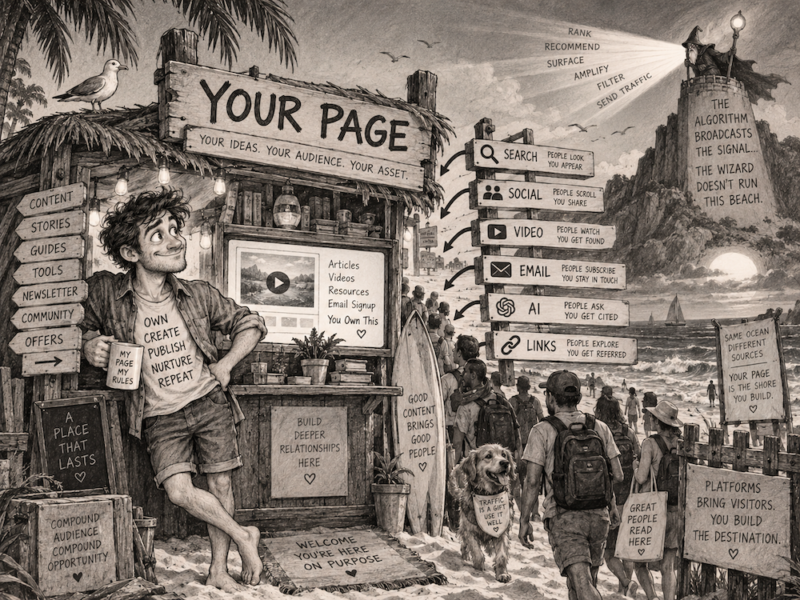
That’s why my 27 X followers don’t bother me much. I can take this Parking Spot and put it on X, LinkedIn, Google, YouTube, Rumble or wherever the useful audience happens to be.
I can turn this story into a Sales Freak YouTube video and embed the video right back into this Parking Spot. The Parking Spot can promote the video. The video can point people back here. Search can find the page. Social media can send traffic. Someone can email the URL.
Now I’ve built my own little marketing loop around something I control.
The platforms can be broadcasters. They don’t have to be my library.
And yes, after this entire adventure I’m curious what Elon Musk’s own distribution looks like on X. Does the Wizard treat the Wizard differently? Does ownership matter? Is his network already so enormous that the question is meaningless?
I have no idea. I’ve argued with enough robots for one weekend. 😂
That sounds like another Sponsors Freak Parking Spot.
And That’s Sponsors Freak
Looking for a sponsor? Build the story. Already have one? Tell the story. Promoting a brand? Show people what you’re doing. Want somebody to sponsor your channel, event, athlete, podcast, business or project? Give them something worth looking at.
A Sponsors Freak Parking Spot is $7 one time. If you like the concept enough to tell other people about Sponsors Freak, you can join the affiliate program for free.
And here’s the part I love:
You just read the product.
This wasn’t a brochure explaining what a Parking Spot could be. This Parking Spot is the example.
I created a piece of content. I can share it, let search engines find it, turn it into a video, embed that video here, update the story and send people back again.
No promise of a million views. No promise the Wizard loves me. No promise my 27 X followers suddenly become 27 million.
Just this:
Create something worth looking at and then go find the right people to show it to.
Apparently Rolex understands that. So does Cadillac. So does Heineken. So does Wilson. So does Carvana.
And yes, Johnny the Sales Freak understands that too. 😂
Want your own Parking Spot? Create one for $7. Use the tools, tell the story and find your audience.
And if you somehow send a million people to it?
I’ll probably ask how you did it.
An algorithm Wizard doesn’t run this beach.