
What Are 100,000 YouTube Views Really Worth in 2026?

THE 60-SECOND AD INSIDE THE VIDEO MIGHT BE WORTH MORE THAN THE VIDEO.
A Sponsors Freak story about YouTube views, sponsorship math, content creation, algorithms, AI, test-marketing ideas and what 100,000 views might really be worth when you build something around them.
Let me start with something that probably makes this whole story more useful.
I AM NOT A YOUTUBE INFLUENCER.
- I created a YouTube channel.
- I created a Rumble channel.
- I started beta testing some videos.
And right now?
Nobody is exactly sitting around waiting for my next upload. 😂
I post on X. I post on Facebook. I write Parking Spots. I broker cars part-time. I broker online advertising.
I have built websites, sold cars, created businesses and used The Cool Car Guy personality for years.
But I have not spent my life trying to become a professional content creator.
Then I started looking at what successful creators can actually earn and thought:
“WAIT A MINUTE. AM I CRAZY NOT TO BE DOING MORE OF THIS?”
And about five minutes later I had another thought:
“WAIT A MINUTE. DO I REALLY WANT TO GIVE MYSELF A JOB?”
That is the question behind this Parking Spot.
And here is the funny part: before I even moved SponsorsFreak.com live, this Parking Spot just sitting on my PrivacySpies staging site had already picked up 29 views.
I was literally test-marketing the idea while writing about test-marketing the idea. 😂
⭐ START WITH THE SPONSORSHIP MATH
Here is a question I think is more interesting than:
“How much money does YouTube pay for 100,000 views?”
What if the better question is:
“What are 100,000 views actually worth?”
Because YouTube revenue may only be the first number.
A 2026 RevenueLab analysis of more than 400 disclosed creator sponsorship deals put typical YouTube long-form integrations around $20–$50 CPM, with dedicated sponsored videos around $50–$120 CPM.
Those are directional market benchmarks, not universal rate cards. But the math gets interesting fast.
| Expected Views | 60–90 Second Integration | Dedicated Sponsored Video |
|---|---|---|
| 10,000 | $200–$500 | $500–$1,200 |
| 50,000 | $1,000–$2,500 | $2,500–$6,000 |
| 100,000 | $2,000–$5,000 | $5,000–$12,000 |
| 500,000 | $10,000–$25,000 | $25,000–$60,000 |
| 1,000,000 | $20,000–$50,000 | $50,000–$120,000 |
THE VIEW COUNT ISN’T JUST A VANITY NUMBER.
TO A SPONSOR, IT CAN BE INVENTORY.
💰 NOW COMPARE THAT TO WHAT YOUTUBE MIGHT PAY
AIR Media-Tech analyzed actual YouTube Analytics from 300 monetized channels and reported a median RPM of about $2.30 per 1,000 views.
| Views | At $2.30 RPM | At $20–$50 Sponsor CPM |
|---|---|---|
| 10,000 | $23 | $200–$500 |
| 100,000 | $230 | $2,000–$5,000 |
| 500,000 | $1,150 | $10,000–$25,000 |
| 1,000,000 | $2,300 | $20,000–$50,000 |
RPM moves all over the place by channel and niche. AIR’s Transport category came in at a directional median of about $5.69 RPM, with a typical middle range of $3.17–$9.81. The sample was small and the spread was large, so I am not calling $5.69 some guaranteed “car RPM.”
But it makes me curious.
At $5.69 RPM, 100,000 views would be about $569.
THE 60-SECOND AD INSIDE THE VIDEO MIGHT BE WORTH MORE THAN THE PLATFORM PAYS FOR THE ENTIRE VIDEO.
Not every time.
But the numbers make it pretty obvious why creators care about sponsors.
And that’s what got me interested and why I created this Parking Spot to discuss it.
After all, if I’m interested in this topic, I’m sure there are a few thousand other people who might be as well.
🚀 SURE — ONE VIDEO CAN BLOW UP
Creators have had one video completely change the trajectory of a channel.
Forbes profiled creator Gohar Khan after one YouTube Short reached nearly 15 million views in a day.
If you’re really bad at math, the temptation is to look at the chart above, multiply 15 million views by that $2.30 RPM and call it $34,500.
I almost did exactly that.
Except this was a YouTube Short, and Shorts use a different revenue model. AIR’s separate 2026 Shorts data shows that Shorts RPM can be dramatically different from long-form YouTube RPM.
So I have no idea what Gohar actually earned from that one Short.
But honestly, that makes my larger point even more interesting.
One piece of content suddenly had nearly 15 million opportunities to create subscribers, sponsors, traffic, follow-up views and whatever else he connected those views to.
Another Forbes profile described comedian Adam Waheed’s fourth online video going viral with roughly 400,000 views overnight. A later T-Mobile sponsorship paid him $20,000 for one video, which pulled more than a million organic views and became a longer partnership.
I am not assuming one of my videos is going to do that.
WHAT IF ONE DOES?
That’s why more people are online creating content.
⭐ YOU DON’T NEED A MILLION SUBSCRIBERS FIRST
SponsorRadar says it has detected more than 1.15 million YouTube sponsorship placements across more than 129,000 tracked channels, involving more than 74,000 sponsoring brands.
That is a lot more companies than the VPN, meal-kit and mattress brands everybody jokes about.
Brands are looking for audiences. Creators have audiences.
The interesting question is whether the two ever find each other.
Now you know why I created Sponsors Freak.
🐹 BUT DO I REALLY WANT TO LIVE ON THE GERBIL WHEEL?
This is where the fantasy meets the job description.
Suppose I make one great video. People watch it. The algorithm likes it. Fantastic.
Now what?
Wednesday comes. Where is the next video?
Friday comes. Where is the next one?
The Baja Bug video worked? Great.
NOW MAKE ANOTHER BAJA BUG VIDEO. 😂
Then Shorts. Then thumbnails. Then comments. Then subscribers. Then somebody tells me my upload schedule is inconsistent.
For some people, even playing a video game on Twitch has literally become a career. What used to be a way to play League of Legends with friends and escape reality for a while can become a content schedule, a subscriber business and another algorithm to feed.
We’ve come a long way from playing Atari on our television screen with a console.
There is absolutely nothing wrong with that business model. Some people love it. Some people are spectacular at it. Some of them have created very high-paying jobs for themselves. Some of them are extremely rich from third-party advertisers.
Some of you reading this might feel like you missed the boat to Fantasy Island.
But I have to ask myself:
AM I BUILDING A BUSINESS THAT USES YOUTUBE?
OR IS YOUTUBE BUILDING ITSELF ANOTHER CONTENT SUPPLIER?
That distinction matters to me.
Mark Zuckerberg does not have to wake up tomorrow and create a funny Facebook Reel to keep Facebook in business. 😂
Elon Musk does not have to wake up every morning and feed X with his own content to keep X in business either.
The platform owner owns the machine.
The creator usually has to keep feeding it.
🎬 AN ACTOR, AN AUTHOR AND A BAND WALK INTO THIS STORY…
Think about an actor for a minute.
They make a film. The film can keep being watched after they go home.
An author writes a book. Stephen King does not have to rewrite The Shining every Thursday to keep it available to a first-time reader.
A band records a song. The band may break up and people can still discover the music twenty years later.
Those creators may choose to make another movie, another book or another album. But the old work does not automatically disappear because they did not upload something this morning.
The work can keep existing, circulating and being discovered without the creator having to manufacture a replacement for it every Wednesday.
THAT IS THE DIFFERENCE I CARE ABOUT: CONTENT THAT BECOMES AN ASSET.
I am not against feeds. I want to use them.
I just do not want my entire business to disappear the minute I stop feeding one.
That’s what I meant about giving myself a job.
And maybe you’ve been thinking the same thing.
Because you’ve maybe visited some YouTube channels from three years ago where the video has 100 views and the person stopped pursuing their dream of showing you how to assemble a popcorn maker you bought on Amazon or get your garage door opener to work on the mirror of your car.
📚 MAYBE JOE KARBO GOT INTO MY HEAD YEARS AGO
Years ago I read The Lazy Man’s Way to Riches by Joe Karbo.
One of the ideas that stuck with me was the power of direct-response advertising and using inexpensive advertising to create income.
Classified ads were part of that world.
Keep in mind, this was back when a kid rode on a bike in the early morning and threw a newspaper onto your driveway.
Yeah, I did that too as a kid, so I’m speaking from experience.
Inside those newspapers were little square boxes called “classified ads”. You could run an ad pretty cheap. Joe used them and other magazines and newspaper advertisements for direct response advertising.
Which is pretty funny considering what I eventually built.
I do not think “lazy” means doing nothing. To me, it means something closer to:
WHY DO EXPENSIVE WORK BEFORE CHEAP WORK TELLS YOU THERE IS A REASON TO DO IT?
That is exactly what bothers me about spending six hours producing a video before I know whether anybody cares about the subject.
I don’t want to spend a weekend grinding out a video about assembling a popcorn machine I bought on Amazon only to have 100 people watch it.
I’m grateful when somebody else made exactly that video on the day I need it. But from the creator’s side, that’s still a lot of work for very little attention.
🧪 FORGET THE FOCUS GROUP. I CAN BUILD ONE FOR SEVEN BUCKS.
If I am going to make a YouTube video, I need an idea anyway.
- I probably need research.
- I need an angle.
- I need a headline.
- I need an outline or a script unless I plan to wing it.
- I need something worth showing.
I can use AI to help me do it so it sounds more like me when I read it. I’m not an English professor.
I’m thinking more like that line in the movie Get Shorty where the guy tells John Travolta, “We can write a movie script. We just need to get someone to put in all of the commas and stuff.”
Then I have to record it, edit it, create a thumbnail, upload it and promote it.
- Maybe I spend two hours that turns into four hours.
- Maybe six.
- Maybe I burn an entire Saturday.
- Maybe a simple video costs me a Weekend.
I’m pretty sure someone reading this who is a full-time content creator can relate.
Content creation can become a pretty sophisticated operation for a one-man or one-woman show competing for attention from the masses.
Your time can disappear into a vacuum pretty fast.
AND THEN IT GETS 25 VIEWS. 😂
That’s enough to have someone suddenly start drinking heavily.
So why would I not test the subject first?
Like that marketing genius Joe Karbo used to do with his classified advertising model.
I already need the writing. I already need the research. I already need the angle.
Turn that work into a $7 Parking Spot.
- Publish it.
- Share it.
- Watch the public view counter.
- See whether anybody even cares.
It will not perfectly predict what YouTube’s algorithm will do. But it can tell me whether the subject itself gets any reaction before I pour more of my limited time into producing the finished video.
BEFORE YOU ASK WHAT 100,000 VIEWS ARE WORTH,
ASK WHAT ZERO VIEWS COST YOU.
If your time is worth $50 an hour and you spend six hours making a video, that is $300 worth of your time invested before anybody watches it.
Seven dollars to test the idea first starts looking pretty cheap.
🤖 AI CHANGED THE EQUATION FOR ME
This is where I think AI becomes the great equalizer.
Wait a minute, you mean those robots living in those giant data centers?
Yes. Those invisible robots that are taking over the world and that trillions of dollars have been invested in that I can use for around $20 a month.
I do not need a marketing degree from Harvard, a graphic-design department and a production studio sitting behind me.
I can open ChatGPT and say:
“Here is the idea. Help me build the Parking Spot. Make it readable. Keep my voice. I will edit it and we will finish it together.”
Then I can create the images.
Then I can take the finished Parking Spot and say:
“Turn this into a five-minute script I can speak on camera. Give me a strong opening. No PowerPoint presentation. No production circus.”
Or maybe I never put my face on camera at all.
I can show screenshots from the Parking Spot, talk over them, use the images, add a catchy title and let the Parking Spot itself be the focal point.
Can somebody build content that way?
YES. YOU CAN.
- You do not have to become a swimsuit influencer.
- You do not have to turn your breakfast into content.
- You do not have to sneak your phone into Planet Fitness.
- You do not have to alienate half of your friends who are in a different political party.
- You do not have to make your entire life the product.
The idea can be the star. You can just be the narrator.
🔁 AND I DON’T THROW THE TEST TUBE AWAY
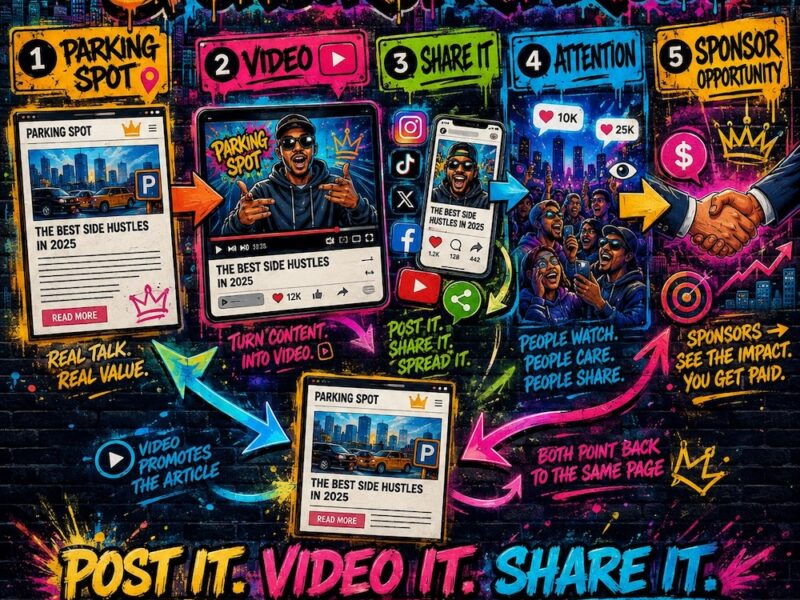
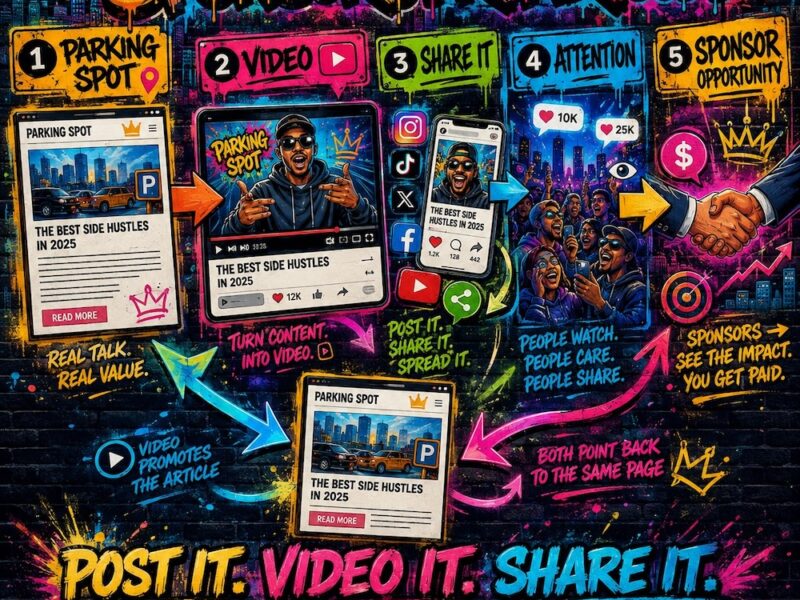
If the idea looks interesting, the Parking Spot I used to test it becomes the foundation of the video.
- 1. Build the Parking Spot.
- 2. Turn it into a short script.
- 3. Record it on camera or narrate the Parking Spot.
- 4. Put the video on YouTube.
- 5. Put it on Rumble.
- 6. Embed both videos back into the Parking Spot.
- 7. Share everything.
Rumble says the same video can be on Rumble and YouTube at the same time.
That’s a win!
Monetization on Rumble depends on the license selected.
I’ll be honest: I’m still figuring out exactly how Rumble’s different licensing choices affect monetization.
At least to me, YouTube currently does a much better job explaining the basic creator-revenue proposition.
The reality is this:
ONE IDEA.
ONE SCRIPT.
ONE PARKING SPOT.
TWO VIDEO PLATFORMS.
THREE DISTRIBUTION POINTS.
The Parking Spot promotes the videos. The videos point people back to the Parking Spot. And all three can keep feeding the same story.
That is what people in marketing and PR call multiple distribution points.
Do you want your story only on one network, or would you rather have it showing up in several places?
You get the point.
🏠 THE PARKING SPOT IS THE ASSET. THE CHANNEL IS DISTRIBUTION.
This may be the most important distinction in the whole experiment.
If the channel is my business, I have to keep feeding the channel.
If the Parking Spot and the Island are the business, I can use YouTube, Rumble, X, Facebook or whatever comes next when those platforms give me leverage.
- I created the Parking Spot.
- I control the page.
- I can edit it.
- If it sucks, I can delete it and build something better.
- If I love it, it stays.
- If it becomes outdated, I can change it or whack it. 😂
And as long as it fits the Island and follows the rules, there is no scheduled expiration forcing the page to disappear because you stopped posting.
The channel is one of the highways leading people back to the asset.
USE THE GERBIL WHEEL.
DON’T LIVE IN IT.
UNLESS IT MAKES ECONOMIC SENSE FOR YOU.
🚗 NOW TRY THE SAME THING WITH A CAR
I own CoolCarGuy.com too.
Suppose I am watching an auction and I spot a sick Baja Bug.
I do not have to buy it for myself.
My wife and I have owned more than 60 vehicles, so we probably do not need to keep adding to that number. 😂
I can build a Cool Car Guy Parking Spot around it:
“I spotted this Baja Bug at auction and I think I can get it bought around X. Before you spend a pile of money on another side-by-side, look at what you could do with this thing.”
Now I have content.
What would another $10,000 do to it?
- Lighting
- Wheels and tires
- Suspension
- A ridiculous business wrap
- Maybe turn it into a rolling billboard somebody actually wants to drive
Then somebody watching asks:
“Can the Cool Car Guy actually get me one of those?”
Yeah.
I probably can.
YOU DON’T HAVE TO OWN THE INVENTORY TO OWN THE STORY.
🌴 NOW ONE STORY CAN HIT THREE DIFFERENT PLACES
CoolCarGuy.com: the Baja Bug itself. What it is, what I can get it for, why it is cool and whether somebody wants me to help get it bought.
CarsFreak.com: the build. The lighting company. The wheel company. The suspension shop. The wrap shop. The parts. The people doing the work.
SponsorsFreak.com: the audience. The videos. The views. The sponsorship opportunity around the whole ridiculous project.
$7 + $7 + $7 = $21.
Maybe I test one idea for $7. Maybe the story deserves three Parking Spots and costs $21. Maybe I build several angles around it and I am still comfortably under $100.
- The YouTube and Rumble channels can be free to publish on.
- AI can help me turn the written stories into video scripts.
- The videos point at the Parking Spots.
- The Parking Spots point at the videos.
And each site tells a different part of the same story to a different audience.
THAT ISN’T JUST CROSS-POSTING.
THAT IS DISTRIBUTION.
🧮 SO WHAT ARE 100,000 VIEWS REALLY WORTH?
We saw earlier that it can be hundreds or even thousands of dollars depending on the success of the video and if it carries a sponsor.
Maybe I asked the wrong question at the beginning.
If a random YouTube video gets 100,000 views, I can look at the RPM and calculate what the platform paid or might pay.
But what if those same views are connected to something?
- YouTube revenue
- Rumble revenue
- A direct sponsor
- Parking Spot traffic
- Advertising customers
- Affiliate commissions
- A vehicle lead or brokerage opportunity
- A parts company or shop
- A follow-up video or an entire series
- Another Parking Spot on another Island
100,000 VIEWS DON’T HAVE ONE VALUE.
Their value depends on what you connected them to before they arrived.
And maybe the most valuable thing the first 100,000 views do is prove that the next piece of content is worth making.
Maybe you spend $7 and see if it’s even worth creating the video at all.
📣 THIS IS EXACTLY WHY I BUILT THESE SITES
I built CoolCarGuy.com and the Freak Sites for myself.
I am going to use them whether anybody else buys a Parking Spot or not.
I think they’re cool and a great marketing tool that allows me to leverage AI and the Internet for my personal brands.
They give me places to build stories, test ideas, publish commentary, create videos, connect subjects and create my own distribution.
Then I looked at the system and thought:
“WHY SHOULD I BE THE ONLY ONE WHO CAN USE IT?”
And why not build a unique, multi-tier Affiliate Program directly into these websites too, so people who want to share the advertising can potentially earn commissions when the advertising sells?
The advertising still has to sell.
So you can use it too.
A Parking Spot is $7 one time.
Up to 30,000 characters. Photos. Videos. Links. Your own dedicated URL. A public view counter. And you can come back and edit it.
You can put your face on camera.
Or don’t.
You can show screenshots of the Parking Spot and narrate it.
You can use AI to help you write it, create visuals and turn it into a script.
You can build a video around it.
Or you can simply publish the page and see what happens.
SEVEN BUCKS ISN’T THE WHOLE BUSINESS MODEL.
IT CAN BE THE COST OF RUNNING THE FIRST EXPERIMENT.
Got an audience, event, brand, sponsorship package, project, product, hobby, business or idea you want to explain in more than a social post?
- Build the page.
- Grab the URL.
- Share it.
- See whether anybody cares.
- If they do, turn it into more.
WRITE IT. PARK IT. SAY IT. SHARE IT.
Then see what happens.
📚 WHERE I GOT THE NUMBERS
I included the source links if you want to dig into the details yourself.
- RevenueLab — Creator Sponsorship Rates in 2026
- SponsorRadar — State of YouTube Sponsorships 2026
- AIR Media-Tech — YouTube RPM in 2026
- AIR Media-Tech — YouTube Shorts RPM in 2026
- Rumble Support — YouTube Videos on Rumble
- Forbes — Gohar Khan
- Forbes — Adam Waheed
⚖️ FOR THE LAWYERS
Sponsorship CPMs, YouTube RPM figures, time-value examples and earnings illustrations on this page are market benchmarks and mathematical examples, not promises of what any creator, video, sponsor or Parking Spot will earn, generate or attract. Actual results vary by audience, niche, format, geography, performance and the deal itself. Rumble monetization depends on the licensing and monetization options selected.